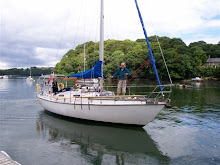
On the 4th Feb 2015 we arrived at Simon’s
Town’s False Bay Yacht Club, Marina and boat yard. A fine and well sheltered
marina in the lee of the Navy dockyard. The facilities were very good and we
found everything we might need without too much trouble. We were even able to
have our anchor chain re-galvanised.
With the
harbour master’s permission, we moved to the slipway wall at high tide. It was
necessary to dry out at low tide, so I could overhaul and re-grease the heads
sea cocks. It was a bit of a shock to get up at 0430 in the dark, to move Sula
to the wall. All went smoothly though, and the work was soon completed.
I
remembered the harbour master comment that this manoeuvre would get the locals
talking, and indeed it did. Several people stopped and commentated that they
hadn’t seen a yacht dried out on the slipway for many years. Still more people
asked how it was done. I wonder if I will start a trend.
Sula drying out
We made
friends with local sailors Nadia and Ray Hartman. They entertained us
wonderfully. We were treated to lunch at their lovely house overlooking the
bay. On another occasion we were taken to the pictures in Cape Town to see the
film of Stephen Hawking’s ‘The theory of everything.’
The
remainder of our time in Simon’s Town was spent relaxing, doing a pleasant walk
that Pippa researched on Swartskop Hill and swimming from a beach near the penguin
colony.
A pleasant walk on
Swartskop Hill.
2nd
March.
The continuous
strong winds we had been experiencing at last died down, and we prepared to sail
to Cape Town early the following day.
There was
hardly a breath of wind, so we motored the whole way, arriving in Cape Town at
five o’clock in the evening. The berth we were allotted turned out to be
occupied, so we tied up at the fuelling berth for the night.
At this
juncture I must apologise to the Royal Cape Yacht club. In the last blog I was
rather disparaging about it. So I must correct myself immediately. Our stay at
the RCYC was most enjoyable. The facilities were excellent, the pontoons safe
and secure, and the staff were without exception courteous and helpful. The
centre of Cape Town is easily reached by taxi and on foot if it is not too
hot.
Kirstenbosch Botanical
Gardens and Nursery Buttress
Friday 6th
March.
Pippa,
having done much research on the internet, found us a fine scramble we could do
on Table Mountain. A 6am start was required. We took a taxi to Kirstenbosch
Botanical Gardens and sweet talked the security guard to let us in, even though
the gardens were not yet open.
The route was Nursery Buttress. A simple
scramble with one short crux section, consisting of a near vertical wall above
a horrible landing, a looong way below our feet. Fortunately the wall was
blessed with huge jug handle holds, on superb clean, dry granite. Interesting scrambling
continued all the way to the top.
There is a summit on Table Mountain, but it
was a long walk from the top of our scramble, so we didn’t bother. The route
was satisfaction enough. The decent, by a simple scramble down Cecilia Ridge,
was pleasant until we came to the lower section that had many knee jarring
steps. But all in all it was a fine day out.
Our next
expedition broke new ground for me. For the first time ever I put myself (and
Pippa of course) in the hands of a professional guide. Reasons were: we didn’t know the mountain; route finding
was complicated; the maps weren’t that good; we hadn’t got much time before we
sailed.
10th
March
We were up
and away by 6am (again) for our guided scramble on Table Mountain. Kloof Corner
Pinnacle was its name, and our friendly and very professional guide was Mike.
It was a thoroughly enjoyable scramble, only marred by having to haul ourselves
up on chains in a couple of places. I’m glad we employed a guide. The route was
quite tricky in a couple of places. With Mike there providing rope work and
route-finding, we could concentrate on enjoying the scrambling and the view.
Table Mountain and
Lion’s Head to the right
12th March.
We walked
into town today It was hot, noisy, dusty and not at all pleasant. We shopped at
Woolworths. (No, not that one) Good quality food, well presented and very
fresh. It was great fun finding our way out of the shopping precinct with a
trolley full of food. We tried one exit, but were turned back by a security
guard. We persevered and eventually found our way to the taxi rank via a
convoluted route involving a lift and a completely different store.
14th March.
We continue
to enjoy Cape Town. Our walk to the summit of ‘Lion’s Head’ today corresponded
with a fell race following the same route. It was a Saturday too, so there were
also hundreds of other visitors to the peak. We shrugged and accepted the
bustle of people ascending and descending our route. Surprisingly enough we
still enjoyed the experience.
Lion’s Head from the
Yacht Club
Our
exertions earned us an evening meal at the Yacht Club. Black olives, feta
cheese and salad for starters, followed by an excellent Mediterranean pizza and
tall glasses of cold beer to help it down. If that wasn't enough, we
shared a table with three German speaking Europeans. “But tonight we speak
English.” And so they did. Perfectly. I feel quite humble sometimes.
Monday.16th
March.
The wind is
howling a force 8 gale, exacerbated by the katabatic winds pouring down the
slopes of Table Mountain. Despite being perfectly safe in harbour, it still makes
us feel edgy. We escaped into town and bought about 30 bottles of emergency water for our next passage and other
goodies. Two large trolley loads. We have a watermaker on board, but still like
to have just enough water stashed away to survive, should the watermaker
break down.This is our second provisioning shop and we will need a third for
fresh meat and veg.
Thursday 19th
March
Following
our successful scramble on Table Mountain with Mike our friendly guide, we were
invited to join him and his girlfriend Eva for a scramble called Outlook Ridge,
on Elsie’s Peak near Fishhook.
This was Mike’s day off work and of course he
was doing what all guides should do, i.e. going climbing with friends. He
described it as one of the best routes in the area. It was very exposed in
places and we were very happy to tie onto the end of his rope. What good
memories we will take with us from our stay in Cape Town.
Outlook Ridge, on
Elsie’s peak
Sunday 22nd March
We tried to
clear customs today. They wouldn’t accept that we have been issued with a visa
extension. This, despite our showing the customs officer the receipt issued in
Durban. This is particularly frustrating because we had been assured that it
wouldn’t be a problem because we had a receipt.
In the end,
after much arguing with both each other and the customs officer, we were
persuaded to be declared undesirable aliens. That done, our paperwork was duly
stamped and filed. Now we must go on line and email a written representation,
with copies of various documents. We were assured this was only a formality and
our undesirable status will be rescinded. But we weren’t hanging around to find
out.
24th
It was beautifully calm this morning, so we finally set sail from Cape Town.
Within an hour of our departure the wind, as usual, piped up. But by that time
we were in clear water and had a fine downwind sail Past Robben Island, where
Nelson Mandela spent much of his life in prison.
By mid-afternoon we arrived
at Dassen Island. We weren’t really
allowed to stop, having cleared customs, but were ready with an excuse in the
very unlikely chance we were challenged.
Our
anchorage at Dassen Island was lovely. Well sheltered from the wind and swell
and with a huge number of all sorts of birds. We instantly decided to stay for
two days. One of our outstanding jobs was to check the watermaker. We couldn’t
do so in Cape Town because of the poor quality of the sea water. I suppose it
served me right, because we really did have a problem with it. It turned (the
beautifully clear) sea water into good quality drinking water, but whilst doing
so also leaked water all over the cabin sole. I eventually sorted the problem
out, so now we really will be able to start our passage tomorrow morning.
We arrived
at St Helena on the 10th April, after 17 days of trouble free
downwind sailing, that included a record breaking day’s run of 155 miles.
Jamestown, Saint
Helena
What a
lovely island. We tied up to a huge yacht-friendly mooring buoy and for the
first time in quite a while we swam from boat. Delightful!
Once we had rested a
little, we took a water taxi ashore for the princely sum of £2 each, return.
This was really good value. It would have been a long row in our inflatable
dinghy. The landing was awash by a considerable surge. It was necessary to
stand on the edge of the water taxi, grab a thick rope secured to an overhead
scaffold and swing Tarzan fashion ashore! Great fun!
The Tarzan swing ropes
(on a calm day)
The harbour
master, customs and immigration officials were all helpful, and clearly
understood visiting sailors. We had accidently left on the boat a document the
custom official required. Normally we would have been sent back immediately to
collect it. But not here, “We do need to see it, so please bring it in next time
you come ashore”.
Once the
dry land stopped wobbling and we had found our land legs, we went sightseeing
with Robert’s Taxi Tour. It was interesting enough and we were able to orient
ourselves a little. Napoleon’s residence was interesting and a good bit smaller
than I had imagined. The governor’s residence “Longwood” was rather grand and
we were amused to see giant tortoises on the lawn. One of which is reputed to
be 180 years old.
Longwood (If you look
very carefully you can see the tortoises)
The British
& St Helena tax payer, are paying for an airport to be built on the island.
The cost is astronomical. The locals are divided on the issue, with a small
majority in favour of its construction.
Now, why is it being built one wonders,
and why is it so huge? It will be able to accommodate very large and fast
military and civil aircraft!
Then one remembers Margaret Thatcher’s Falklands
War. Of course, there is oil to be found in Antarctica. Possession of the
Falklands entitles us to a bigger slice of that remote continent. We might even
need to dissuade Argentina again, from claiming sovereignty over a group of islands clearly
on their continental shelf.
Pippa’s folly
15th
April
Pippa and I
went for a walk to the Sugar Loaf Hill. It started along a dirt track
overlooking the sea. There was no hiding from the ferocity of the sun. It was
incredibly hot, but we persevered. Near the summit, Pippa discovered a prickly
pear cactus that she decided was in need of investigation. I think she must
have had a tad too much sun. It resulted in her spending the rest of the day
picking spines out of her hand. Having descended from the summit we retraced
our route and headed for the shady gardens behind the Courtyard Café, for iced
drinks.
Val Joshua & Dee
19th
April,
Our next
and final walk was in the excellent company of Val Joshua. Val is a bit of a
legend in St. Helena. She loves walking, especially in the company of like-minded
souls. We chose Diana’s Peak, a simple but very pleasant ramble. Unfortunately
much of the time we were in quite thick mist. We had a very pleasant outing
nonetheless.
Val Joshua & Pippa
20th
April
The RMS (Royal
Mail Ship) St. Helena came in on Sunday with essential supplies. It was
fascinating to watch her unloading. A stream of boats ferried containers and
cargo nets to the jetty and their cargo was lifted aboard by a large crane on
wheels.
The RMS is one of 2 remaining mail ships. With the arrival of the
airport, it will be decommissioned early 2016. From 1502 until 2016 the only
way to reach St Helena has been by sea.
We sailed
next day on the 2100 mile passage to the Cape Verde Islands. We had fine weather
as far as the Equator. But then had the ITCZ (Doldrums) to contend with. There
were intermittent calms, squalls and threatening black clouds. It was very hot,
and very frustrating.
And then the problems started.
And then the problems
started…
There was
no wind, so I reached for the tin sail, but to my horror the engine wouldn’t
start. We have three batteries on board and they were all completely flat. I
think we had been overusing the watermaker.
We were, however
pleased to see a black cloud approach and drop a deluge of water on us. As
quick as we could, we rigged an awning and collected several gallons of rain
into our water tank.
We then
drifted all night and wished for some wind. We did eventually find a zephyr and
morale improved a bit, but not for long. Next on the list of mishaps the GPS
packed up. I narrowed it down to a fault on the antenna. But there was nothing
to be done. Fortunately, we carry a hand held GPS, and Pippa has an ipad with
an integral GPS and electronic charts.
Next day we
found that our two big batteries were completely flat and wouldn’t charge from
the solar panels. Fortunately the smaller one would. We were now able to start
the engine, but had to be really strict and not use it for anything except engine starting.
16th
May
We arrived
at Praia on the island of Santiago on the 16th May. It wasn’t
somewhere we would want to revisit. We were at anchor and it was difficult to
get ashore. We had a long paddle to the fisherman’s dock where we had to
transfer to another dinghy to get to a place where we could scramble up a steep
slippery bank to get ashore. We settled for just buying a few provisions and
fuel before setting of again.
Praia. It wasn’t
somewhere we would want to revisit.
20th
May.
We sailed
on to Tarrafal in the north of the island to break the journey, and anchored in
a pleasant bay overnight. The following day we set off on the 120 mile sail to Mindelo,
on the island of Sao Vicente. We had three reefs in the mainsail and just a
tiny bit of gib sail.
We tried hard
to reach Mindelo, but wind and tide in the channel between Sao Vicente and
Santo Antao was on the nose and just too strong.
We retreated
to Sao Pedro on the west side of Sao Vicente. The wind was still blowing hard,
but as we approached the anchorage we escaped the swell. We were watching the
depth as we sought the best place to drop the hook.
Suddenly, we spontaneously
ducked as a large commercial aeroplane coming into land screamed over our heads.
It really looked as though it might clip the top of the mast, though I’m sure
that was just an illusion. Our anchor bit well into the sand and we let out
double the length of chain that we really needed. What the heck, there was
plenty of room and we were safe and secure. We read in the pilot book that we
had anchored in one of the best wind surfing venues in the world!
Later that
afternoon, We noted that a large orange and very official looking power boat
was taking a lot of interest in us. Paranoia set in. Were we going to be
arrested for endangering an aeroplane.
The boat came nearer then backed off. I
called them on the VHF radio but the language barrier prevented communication.
Then they got closer and closer, and a man in uniform seemed to be preparing to
leap aboard. But at the last moment the boat backed off again. It was too
dangerous. Then as quickly as they had arrived, they lost interest in us, and
started escorting a dozen or so fishing boats full of children on a circuit
around the bay. And that was the last we saw of them. Thank goodness.
23rd May
In the
morning the wind had abated considerably, but was still strong.We left Sao
Pedro at 0500 just as it was getting light, and motored at full speed towards
Mindelo. I say full speed, but the best we could manage against the wind and
current was two knots!
By mid-morning however, we were tucked up in the shelter
of Mindelo Harbour on a marina pontoon. Then we started work. Once we had
cleared customs we found a Mr Fix It who got us a new antenna for our GPS, and
a new screen for our laptop. Next was to find and buy two new, heavy duty batteries.
Once I had fitted them, we bought a couple of extra jerry cans and filled our
tanks with diesel fuel. A shopping trip for provisions and to fill our gas
bottles were the final chores.
We enjoyed
our short stay in Mindelo. There was a little swell in the harbour, but not too
much. The locals were friendly and helpful, and nearly everything we needed was
within walking distance.
Leaving Mindelo
On the 30th
of May we left the marina and anchored for the night in the harbour in order to
make a quick departure for Azores. We were faced with eight
hours of motoring against a strong wind, to escape the channel between the two
islands.
It wasn’t
the easiest of passages, we had light winds and/or no wind much of the time.
For the last four days we were in the Azores High and completely becalmed.
Fortunately we had foreseen this problem and had taken plenty of fuel in jerry
cans.
Angra do Heroismo.
We arrived in
Angra do Heroismo, on the island of Terceira in the Azores on the 15th
of June. What a fantastic place. A quiet marina, with helpful staff. A picturesque
town, with red roofs. The green slopes of Monty Brazil.
But oh
dear, did I say a quiet town? We have arrived just in time for the Sao Joao
festivities. Last night, until the small hours, we were treated to three bands,
with different types of music playing at full blast, all at the same time!
The evening
before, it has to be said, we were out in the streets with the locals, watching
the colourful processions and listening to the brass bands. It was quite
something to be part of such benevolent, multi-generational crowds. The streets
are illuminated, people hang patchwork tapestries from balconies, there is
plenty of food and drink from numerous cafes and sandwich bars. People are
enjoying themselves!
This is
technically the completion of our circumnavigation. Not that that matters very
much, for there still remains half the Atlantic Ocean to cross before reaching our
Llangwm home. The weather is not what it could be for the crossing, so we are
waiting patiently and watching the Grib files before setting off on the home
leg of our odyssey.
I will of course send you an Email ASAP after our arrival in Llangwm.
St. Helena steps
Quite right
RMS St Helena